library(INLAvaan)
library(blavaan)
#> Loading required package: Rcpp
#> This is blavaan 0.6-1
#> On multicore systems, we suggest use of future::plan("multicore") or
#>   future::plan("multisession") for faster post-MCMC computations.
set.seed(161)

# Generate data
n <- 250
truval <- c(0.8, 0.7, 0.6, 0.5, 0.4, -1.43, -0.55, -0.13, -0.72, -1.13)
dat <- lavaan::simulateData(
  "eta =~ 0.8*y1 + 0.7*5y2 + 0.6*y3 + 0.5*y4 + 0.4*y5
   y1 | -1.43*t1
   y2 | -0.55*t1
   y3 | -0.13*t1
   y4 | -0.72*t1
   y5 | -1.13*t1",
  ordered = TRUE,
  sample.nobs = n
)
head(dat)
#>   y1 y2 y3 y4 y5
#> 1  2  2  1  2  2
#> 2  2  1  1  1  2
#> 3  2  2  2  1  2
#> 4  1  1  1  1  2
#> 5  2  2  1  2  2
#> 6  2  2  1  1  1

# Fit INLAvaan model
mod <- "eta  =~ y1 + y2 + y3 + y4 + y5"
fit <- acfa(mod, dat, ordered = TRUE, std.lv = TRUE, estimator = "PML")
#> ℹ Mode finding and Hessian computation.
#> ✔ Posterior mode and Hessian. [223ms]
#>
#> ℹ Performing VB correction.
#> ✔ VB correction; mean |δ| = 0.325σ. [1.7s]
#>
#> ⠙ Fitting 0/10 skew-normal marginals.
#> ⠹ Fitting 8/10 skew-normal marginals.
#> ✔ Fit 10/10 skew-normal marginals. [732ms]
#>
#> ⠙ Posterior sampling and summarising.
#> ✔ Summarise 1000 posterior draws. [1.3s]
#>
#> ℹ Fit measures: PPP, DIC.
summary(fit)
#> INLAvaan 0.3.2.9003 ended normally after 34 iterations
#>
#>   Estimator                                      BAYES
#>   Optimization method                           NLMINB
#>   Number of model parameters                        10
#>
#>   Number of observations                           250
#>
#> Model Test (User Model):
#>
#>    Marginal log-likelihood                   -1104.781
#>    PPP (Chi-square)                              0.000
#>
#> Information Criteria:
#>
#>    Deviance (DIC)                             2161.418
#>    Effective parameters (pD)                     8.505
#>
#> Parameter Estimates:
#>
#>    Parameterization                              Theta
#>    Marginalisation method                     SKEWNORM
#>    VB correction                                  TRUE
#>
#> Latent Variables:
#>                    Estimate       SD     2.5%    97.5%     NMAD    Prior
#>   eta =~
#>     y1                1.077    0.393    0.475    1.986    0.049  normal(0,10)
#>     y2                0.734    0.283    0.298    1.387    0.049  normal(0,10)
#>     y3                0.755    0.290    0.303    1.421    0.029  normal(0,10)
#>     y4                0.897    0.339    0.385    1.684    0.031  normal(0,10)
#>     y5                0.477    0.213    0.118    0.948    0.021  normal(0,10)
#>
#> Thresholds:
#>                    Estimate       SD     2.5%    97.5%     NMAD    Prior
#>     y1|t1            -2.258    0.427   -3.257   -1.629    0.032 normal(0,1.5)
#>     y2|t1            -0.831    0.145   -1.168   -0.613    0.080 normal(0,1.5)
#>     y3|t1            -0.306    0.092   -0.510   -0.152    0.023 normal(0,1.5)
#>     y4|t1            -0.843    0.167   -1.232   -0.597    0.057 normal(0,1.5)
#>     y5|t1            -1.282    0.147   -1.620   -1.054    0.062 normal(0,1.5)
#>
#> Variances:
#>                    Estimate       SD     2.5%    97.5%     NMAD    Prior
#>    .y1                1.000
#>    .y2                1.000
#>    .y3                1.000
#>    .y4                1.000
#>    .y5                1.000
#>     eta               1.000
#>
#> Scales y*:
#>                    Estimate       SD     2.5%    97.5%     NMAD    Prior
#>     y1                1.500    0.294    1.110    2.179
#>     y2                1.259    0.171    1.045    1.686
#>     y3                1.269    0.177    1.046    1.706
#>     y4                1.357    0.234    1.066    1.956
#>     y5                1.121    0.096    1.007    1.377
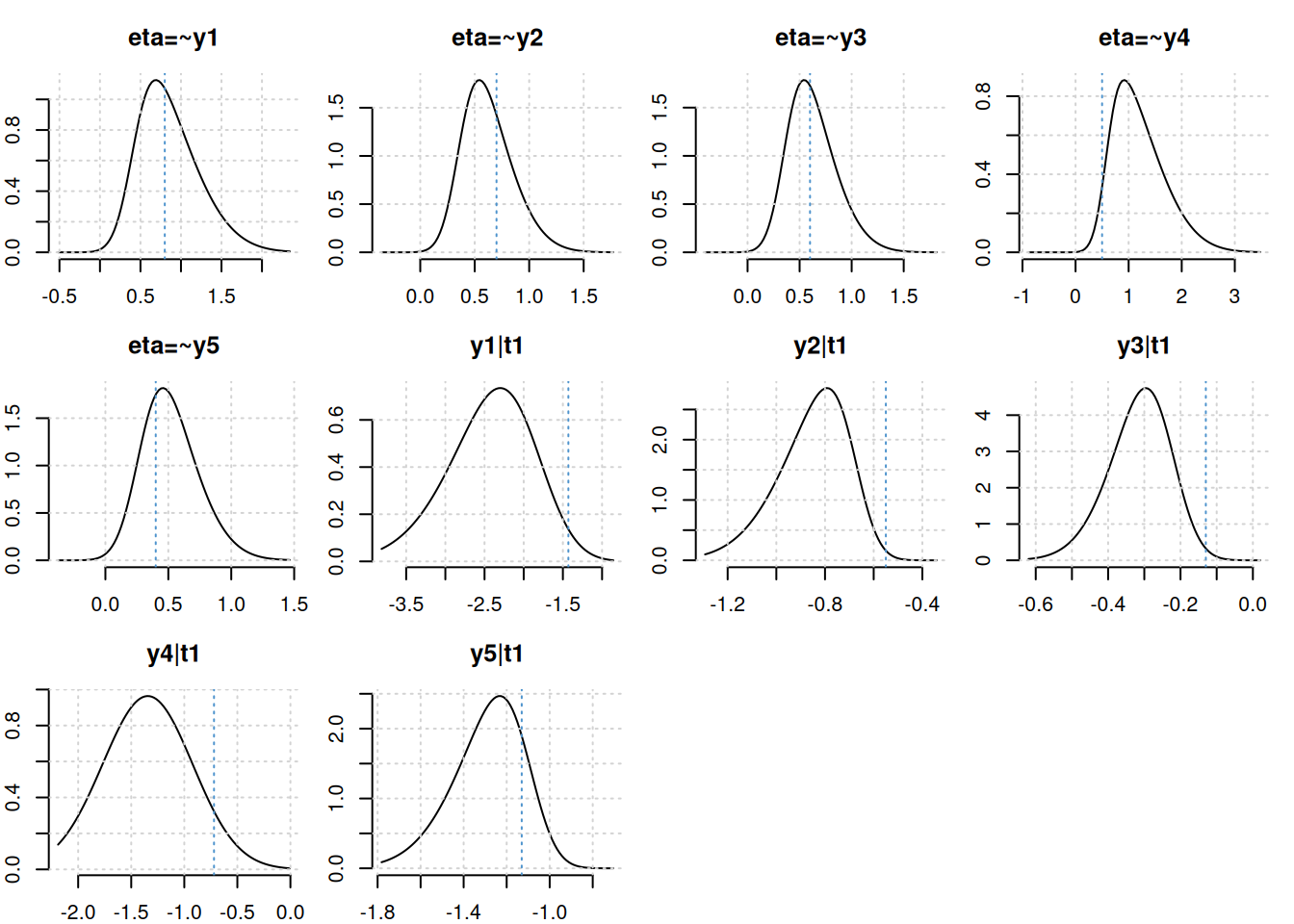
plot(fit, truth = truval)