
Introduction
SEMs are ubiquitous in the social sciences, psychology, ecology, and other fields. The INLAvaan package (Jamil and Rue 2026b) provides a user-friendly interface for fitting Bayesian SEMs using Integrated Nested Laplace Approximations (INLA, Rue et al. 2009), based on a bespoke approximate Bayesian inference framework for SEMs (Jamil and Rue 2026a). This vignette will guide you through the basics of using INLAvaan to fit a simple SEM. Before we begin make sure you have installed the INLAvaan package from GitHub by running the commands below.
Motivating example
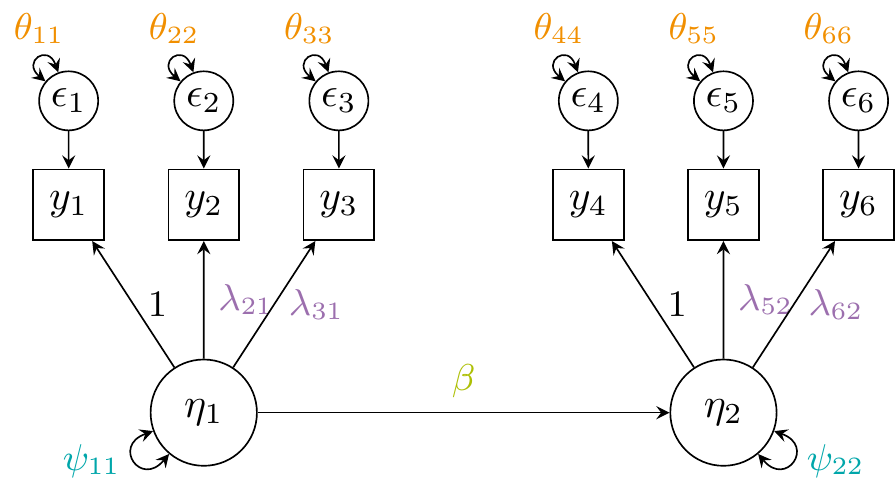
To motivate the use of SEMs, consider the introductory example in Song and Lee (2012): Does poorer glycemic control lead to greater severity of kidney disease? We observe three indicators of glycemic control (, , ) and three indicators of kidney disease severity (, , ).
| Indicator | Description | Unit | |
|---|---|---|---|
| HbA1c | 3-month avg. blood glucose | % | |
| FPG | Fasting plasma glucose | mmol/L | |
| Insulin | Fasting insulin level | μU/mL | |
| PCr | Plasma creatinine | μmol/L | |
| ACR | Albumin–creatinine ratio | mg/g | |
| BUN | Blood urea nitrogen | mmol/L |
Rather than fitting separate regression models for each indicator, SEM allows us to model the relationship between the latent constructs themselves, providing a clearer and more coherent representation of the underlying processes. The hypothesised SEM is illustrated by the figure below:
Data
For the two-factor SEM we described above, it is easy to simulate some data using the lavaan package to do so. The code is below:
pop_mod <- "
  eta1 =~ 1*y1 + 0.8*y2 + 0.6*y3
  eta2 =~ 1*y4 + 0.8*y5 + 0.6*y6
  eta2 ~ 0.3*eta1

  # Variances
  y1 ~~ 0.5*y1
  y2 ~~ 0.5*y2
  y3 ~~ 0.5*y3
  y4 ~~ 0.5*y4
  y5 ~~ 0.5*y5
  y6 ~~ 0.5*y6
  eta1 ~~ 1*eta1
  eta2 ~~ 1*eta2
"
set.seed(123)
dat <- lavaan::simulateData(pop_mod, sample.nobs = 1000)
str(dat)
#> 'data.frame':    1000 obs. of  6 variables:
#>  $ y1: num  1.146 1.495 -1.246 -0.109 1.092 ...
#>  $ y2: num  0.911 0.724 -1.26 0.765 2.198 ...
#>  $ y3: num  0.922 -0.208 -0.486 -0.7 1.305 ...
#>  $ y4: num  -0.142 -0.379 -0.962 0.381 -2.822 ...
#>  $ y5: num  0.229 -0.5 -0.94 -1.222 -1.552 ...
#>  $ y6: num  -0.436 -0.219 -2.159 0.484 0.839 ...
From the code above, note the true values of the parameters, including the factor loadings , regression coefficient between the two latent variables, as well as the residual and latent variances and respectively.
Model fit
Now that we have simulated some data, we can fit the SEM using INLAvaan. The model syntax is similar to that of lavaan, making it easy to specify the model. For further details on the model syntax, refer to the lavaan website. INLAvaan provides mirror functions for the main model fitting functions in lavaan:
-
acfa()mirrorslavaan::cfa()for confirmatory factor analysis; and -
asem()mirrorslavaan::sem()for structural equation models; -
agrowth()mirrorslavaan::growth()for latent growth curve models.
The code to fit the SEM model is below:
mod <- "
  eta1 =~ y1 + y2 + y3
  eta2 =~ y4 + y5 + y6
  eta2 ~ eta1
"
fit <- asem(mod, dat)
#> ℹ Mode finding and Hessian computation.
#> ✔ Posterior mode and Hessian. [283ms]
#>
#> ℹ Performing VB correction.
#> ✔ VB correction; mean |δ| = 0.037σ. [192ms]
#>
#> ⠙ Fitting 0/13 skew-normal marginals.
#> ✔ Fit 13/13 skew-normal marginals. [483ms]
#>
#> ⠙ Posterior sampling and summarising.
#> ✔ Summarise 1000 posterior draws. [628ms]
#>
#> ℹ Fit measures: PPP, DIC.
As with lavaan::sem(), this model is fitted without a mean structure by default (meanstructure = FALSE). Rather than profiling the means out as lavaan does, INLAvaan assigns the saturated means flat priors and marginalises them analytically, which keeps the likelihood a proper Bayesian object. Intercepts can instead be modelled explicitly with meanstructure = TRUE. See the mean structures article for how the two treatments relate and when model comparisons across them are meaningful.
INLAvaan computes an approximation to the posterior density by way of a Laplace approximation (Tierney et al. 1989; Jamil and Rue 2026a). The joint mode and the Hessian needs to be computed, which gives a Gaussian distribution for the joint posterior of the parameters. The default method for optimisation is stats::nlminb(), but other optimisers can be used by specifying optim_method = "ucminf" for the ucminf package or optim_method = "optim" to call the stats::optim() function with method "BFGS".
From this, marginal posterior distributions for each parameter can be obtained by one of several ways, including 1) Skew normal fitting (marginal_method = "skewnorm", the default method, see Chiuchiolo et al. 2023); 2) Two-piece asymmetric Gaussian fitting (marginal_method = "asymgaus", see Martins et al. 2013); 3) Direct marginalisation of the joint Gaussian posterior (marginal_method = "marggaus"); and 4) Sampling from the joint Gaussian posterior (marginal_method = "sampling").
Once the marginal posterior distributions have been obtained, we can further use these to compute any derived quantities of interest via copula sampling. The posterior predictive p-values (Gelman et al. 1996) and Deviance Information Criterion (DIC, Spiegelhalter et al. 2002) are computed this way. The test argument names which of these post-estimation quantities to compute: the default test = "standard" computes the PPP and the DIC, test = "full" adds the leave-one-out cross-validation and WAIC results (see the model comparison section below) and stores them with the fit, and test = "none" skips them all. Often, the posterior sampling takes longer than the model fitting itself, so the number of samples can be controlled via the nsamp argument (default is nsamp = 1000).
Methods
The resulting object is of class INLAvaan, a subclass of lavaan objects.
str(fit, 1)
#> Formal class 'INLAvaan' [package "INLAvaan"] with 21 slots
fit
#> INLAvaan 0.3.2.9003 ended normally after 64 iterations
#>
#>   Estimator                                      BAYES
#>   Optimization method                           NLMINB
#>   Number of model parameters                        13
#>
#>   Number of observations                          1000
#>
#> Model Test (User Model):
#>
#>    Marginal log-likelihood                   -8078.220
#>    PPP (Chi-square)                              0.317
As a result, most of the methods that work for lavaan objects will also work for INLAvaan objects. The most common ones are probably coef() and summary().
# Inspect coefficients
coef(fit)
#>   eta1=~y2   eta1=~y3   eta2=~y5   eta2=~y6  eta2~eta1     y1~~y1     y2~~y2
#>      0.873      0.601      0.786      0.582      0.272      0.487      0.499
#>     y3~~y3     y4~~y4     y5~~y5     y6~~y6 eta1~~eta1 eta2~~eta2
#>      0.489      0.476      0.465      0.523      1.052      0.934

# Summary of results
summary(fit)
#> INLAvaan 0.3.2.9003 ended normally after 64 iterations
#>
#>   Estimator                                      BAYES
#>   Optimization method                           NLMINB
#>   Number of model parameters                        13
#>
#>   Number of observations                          1000
#>
#> Model Test (User Model):
#>
#>    Marginal log-likelihood                   -8078.220
#>    PPP (Chi-square)                              0.317
#>
#> Information Criteria:
#>
#>    Deviance (DIC)                            16063.380
#>    Effective parameters (pD)                    13.059
#>
#> Parameter Estimates:
#>
#>    Marginalisation method                     SKEWNORM
#>    VB correction                                  TRUE
#>
#> Latent Variables:
#>                    Estimate       SD     2.5%    97.5%     NMAD    Prior
#>   eta1 =~
#>     y1                1.000
#>     y2                0.873    0.042    0.792    0.958    0.005    normal(0,10)
#>     y3                0.601    0.032    0.540    0.665    0.003    normal(0,10)
#>   eta2 =~
#>     y4                1.000
#>     y5                0.786    0.042    0.707    0.870    0.006    normal(0,10)
#>     y6                0.582    0.034    0.517    0.650    0.003    normal(0,10)
#>
#> Regressions:
#>                    Estimate       SD     2.5%    97.5%     NMAD    Prior
#>   eta2 ~
#>     eta1              0.272    0.038    0.198    0.348    0.001    normal(0,10)
#>
#> Variances:
#>                    Estimate       SD     2.5%    97.5%     NMAD    Prior
#>    .y1                0.487    0.047    0.395    0.580    0.004 gamma(1,.5)[sd]
#>    .y2                0.499    0.039    0.425    0.577    0.002 gamma(1,.5)[sd]
#>    .y3                0.489    0.027    0.439    0.544    0.000 gamma(1,.5)[sd]
#>    .y4                0.476    0.050    0.379    0.574    0.006 gamma(1,.5)[sd]
#>    .y5                0.465    0.035    0.399    0.535    0.002 gamma(1,.5)[sd]
#>    .y6                0.523    0.028    0.470    0.581    0.000 gamma(1,.5)[sd]
#>     eta1              1.052    0.077    0.906    1.209    0.003 gamma(1,.5)[sd]
#>    .eta2              0.934    0.073    0.797    1.082    0.004 gamma(1,.5)[sd]
It’s possible to request posterior medians and modes in the summary output by specifying postmedian = TRUE or postmode = TRUE in the summary() function.
Predictions
Predicted values for the latent variables can be obtained using the predict() function. This is done by sampling from the posterior distributions of the latent variables given the observed data. The function also supports predictions for observed variables (e.g. type = "ov") and missing data imputation, respecting multilevel structure if present.
This is an S3 object with a summary method that provides posterior means and credible intervals for the latent variables. Alternatively, the user is welcome to perform their own summary statistics on the list of posterior samples returned by predict().
summ_eta <- summary(eta_preds)
str(summ_eta)
#> List of 7
#>  $ group_id: NULL
#>  $ Mean    : num [1:1000, 1:2] 0.9486 0.7523 -1.1022 0.0339 1.3809 ...
#>   ..- attr(*, "dimnames")=List of 2
#>   .. ..$ : NULL
#>   .. ..$ : chr [1:2] "eta1" "eta2"
#>  $ SD      : num [1:1000, 1:2] 0.461 0.421 0.451 0.412 0.414 ...
#>   ..- attr(*, "dimnames")=List of 2
#>   .. ..$ : NULL
#>   .. ..$ : chr [1:2] "eta1" "eta2"
#>  $ 2.5%    : num [1:1000, 1:2] 0.2009 -0.0306 -2.0993 -0.7831 0.5795 ...
#>   ..- attr(*, "dimnames")=List of 2
#>   .. ..$ : NULL
#>   .. ..$ : chr [1:2] "eta1" "eta2"
#>  $ 50%     : num [1:1000, 1:2] 0.8701 0.7347 -1.0661 0.0155 1.4003 ...
#>   ..- attr(*, "dimnames")=List of 2
#>   .. ..$ : NULL
#>   .. ..$ : chr [1:2] "eta1" "eta2"
#>  $ 97.5%   : num [1:1000, 1:2] 1.949 1.65 -0.411 0.811 2.273 ...
#>   ..- attr(*, "dimnames")=List of 2
#>   .. ..$ : NULL
#>   .. ..$ : chr [1:2] "eta1" "eta2"
#>  $ Mode    : num [1:1000, 1:2] 0.8178 0.7294 -0.9755 -0.0624 1.4156 ...
#>   ..- attr(*, "dimnames")=List of 2
#>   .. ..$ : NULL
#>   .. ..$ : chr [1:2] "eta1" "eta2"
#>  - attr(*, "class")= chr "summary.predict.inlavaan_internal"
head(summ_eta$Mean)
#>             eta1        eta2
#> [1,]  0.94862299 -0.00171860
#> [2,]  0.75234902 -0.30954587
#> [3,] -1.10218436 -1.24392813
#> [4,]  0.03388246 -0.08880278
#> [5,]  1.38090771 -1.55316748
#> [6,] -1.75458945 -0.92234954
Predictive checks
The generative side of the model is exposed by sampling(), which draws parameters, latent variables, or observed variables from the posterior (or prior) generative SEM, and by simulate(), which produces complete replicate data sets from the fitted model.
yrep <- simulate(fit, nsim = 1, seed = 1)
head(yrep[[1]])
#>           y1         y2         y3           y4         y5         y6
#> 1  0.8813496  1.4603414 -0.2683892 -1.563283631 -1.4732048 -0.7336630
#> 2  2.3150808  1.6290676  0.3387869  2.143638101  0.5760444  0.2955467
#> 3 -0.3179253  0.5502545 -1.3678301 -2.451358072 -2.9058180 -1.1054853
#> 4 -0.8738084  1.9191274 -0.2880075 -0.786340907 -0.4587041 -0.6197135
#> 5 -2.9240899 -1.3077655 -1.4121739 -2.173515719 -1.3151876 -0.6288778
#> 6 -1.4205185 -0.3729534 -1.0339376  0.002804593 -0.2025988  1.0604545
Comparing such replicates with the observed data is the basis of prior and posterior predictive checking. The predictive checks article walks through that workflow, and the sampling article explains the machinery behind it.
Fit measures
Global fit measures are collected by fitmeasures(): the PPP and DIC mentioned earlier, Bayesian analogues of the classical fit indices (BRMSEA, BGammaHat, and related indices), and the LOO and WAIC measures of the model comparison section below when these are stored with the fit.
fitmeasures(fit)
#>         npar   margloglik          ppp          dic        p_dic       BRMSEA
#>           13    -8078.220        0.317    16063.380       13.059        0.017
#>    BGammaHat adjBGammaHat          BMc         BCFI         BTLI         BNFI
#>        0.999        0.997        0.998        0.998        0.997        0.994
Definitions and worked examples are in the Bayesian fit indices article.
Diagnostics
The diagnostics() function reports convergence and approximation-quality metrics for the fitted model. Global diagnostics (type = "global") check whether the optimiser converged, and quantify how well the skew-normal marginals match the joint posterior (via KL divergence and NMAD), including how much mass a fitted marginal leaves beyond the window that was scanned to fit it (scan_end_mass_max). Per-parameter diagnostics (type = "param") provide gradient norms and KL contributions for each free parameter, which is useful for identifying any problematic parameters.
diagnostics(fit)
#>              npar             nsamp         converged        iterations
#>                13              1000                 1                64
#>          grad_inf      grad_inf_rel           grad_l2    mode_shift_max
#>          3.46e-03          7.17e-02          6.60e-03          4.33e-04
#>         hess_cond        vb_applied      vb_shift_max     vb_kld_global
#>          2.99e+01                 1            0.0883            0.0110
#>           kld_max          kld_mean       vb_mcse_max      vb_mcse_mean
#>            0.0039            0.0010            0.0855            0.0295
#>          nmad_max         nmad_mean scan_end_mass_max
#>            0.0064            0.0031          3.15e-04
The timing() function reports how long each computation stage took, which can help identify bottlenecks when scaling to larger models.
timing(fit)
#>  total
#> 1.66 s
Plot
A simple plot method is provided to view the marginal posterior distributions of the parameters. The vertical lines indicate the posterior mode.
plot(fit)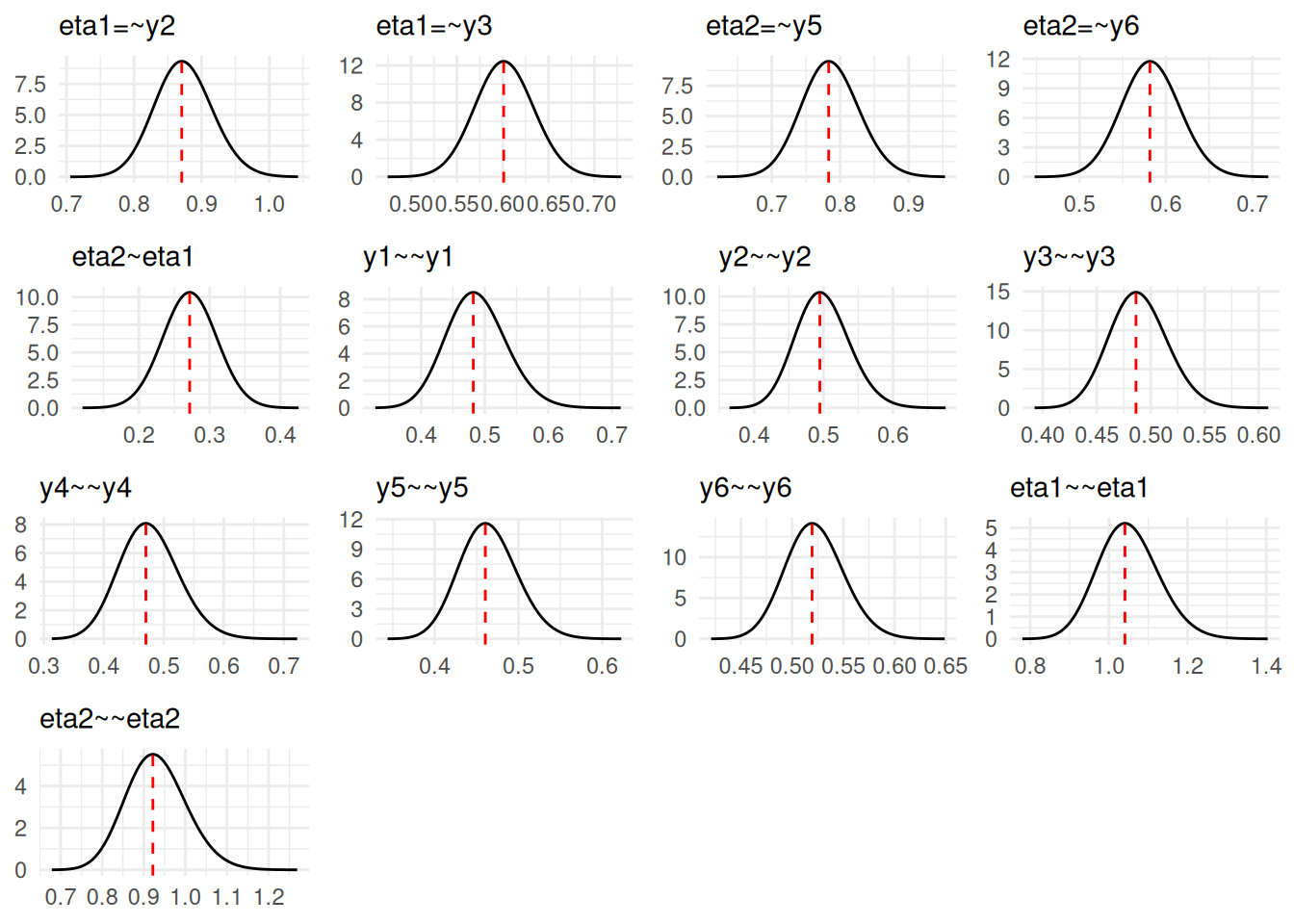
Model comparison
In addition to several global fit indices (i.e. PPP, DIC), it is possible to compare models by way of Bayes factors using the compare() function. This function takes two INLAvaan objects and computes the Bayes factor using the Laplace approximations to the marginal likelihoods.
mod2 <- "
  # A model with uncorrelated factors
  eta1 =~ y1 + y2 + y3
  eta2 =~ y4 + y5 + y6
  eta1 ~~ 0*eta2
"
fit2 <- asem(mod2, dat)
#> ℹ Mode finding and Hessian computation.
#> ✔ Posterior mode and Hessian. [129ms]
#>
#> ℹ Performing VB correction.
#> ✔ VB correction; mean |δ| = 0.041σ. [218ms]
#>
#> ⠙ Fitting 0/12 skew-normal marginals.
#> ✔ Fit 12/12 skew-normal marginals. [393ms]
#>
#> ⠙ Posterior sampling and summarising.
#> ✔ Summarise 1000 posterior draws. [721ms]
#>
#> ℹ Fit measures: PPP, DIC.
compare(fit, fit2)
#> Bayesian Model Comparison (INLAvaan)
#> Models ordered by marginal log-likelihood
#>
#>  Model npar Marg.Loglik  logBF      DIC     pD
#>    fit   13    -8078.22   0.00 16063.38 13.059
#>   fit2   12    -8098.55 -20.33 16113.21 11.935
As a note, there have been several criticisms of the use of Bayes factors for model comparison, particularly in the context of SEMs (Tendeiro and Kiers 2019; Schad et al. 2023). Leave-one-out cross-validation (LOO, Vehtari et al. 2017) and the widely applicable information criterion (WAIC, Watanabe 2010) are popular alternatives which compare models on out-of-sample predictive accuracy instead; see Merkle et al. (2019) for their use with latent variable models. Both are implemented in INLAvaan. The functions loo() and waic() require neither refitting nor sampling: both are computed in closed form from the same Taylor expansion around the fit’s Laplace summary.
loo(fit)
#> ── Leave-one-subject-out ──────────────────────── 1000 subjects, second-order ──
#>
#>          Estimate    SE
#> elpd_loo  -8021.9  54.0
#> p_loo        13.0   0.5
#> looic     16043.9 108.0
#>
#> ── Curvature check ─────────────────────────────────────────────────────────────
#>
#>   first-to-second-order gap         6.6
#>   pD/2 (trace)                      6.5
#>   excess over pD/2 (trace)        +1.2%
#>
#> ℹ The gap approaches pD/2 (trace) from above. A large excess says the
#>   second-order expansion has not settled over the sample.
To compare models on this predictive scale, pass loo = TRUE to compare(). Models are sorted by expected log predictive density (ELPD), with paired standard errors for the ELPD differences.
compare(fit, fit2, loo = TRUE)
#> Bayesian Model Comparison (INLAvaan)
#> Models ordered by ELPD (Taylor LOO, second-order)
#> elpd_diff/se_diff are paired differences vs the best model
#>
#>  Model npar Marg.Loglik  logBF      DIC     pD      ELPD     SE  p_loo
#>    fit   13    -8078.22   0.00 16063.38 13.059 -8021.947 53.991 13.039
#>   fit2   12    -8098.55 -20.33 16113.21 11.935 -8046.999 54.298 12.021
#>  elpd_diff se_diff
#>      0.000   0.000
#>    -25.052   7.151
See the cross-validation article for the methodology and more advanced usage, including multigroup and two-level models, missing data, and scoring submodels without refitting.
Setting priors
The INLAvaan package uses the same prior specification syntax as blavaan (Merkle and Rosseel 2018; Merkle et al. 2021), as detailed here. Essentially, there are two ways to set priors for model parameters: 1) Globally for all parameters of a certain type (e.g., all factor loadings, all regression coefficients, etc.); and 2) Individually for specific parameters in the model syntax.
The default global priors are similar to those from blavaan:
priors_for()  # similar to blavaan::dpriors()
#>                nu             alpha            lambda              beta
#>    "normal(0,32)"    "normal(0,10)"    "normal(0,10)"    "normal(0,10)"
#>              wmat             theta               psi               rho
#>    "normal(0,10)" "gamma(1,.5)[sd]" "gamma(1,.5)[sd]"       "beta(1,1)"
#>               tau
#>   "normal(0,1.5)"
Note that, INLAvaan uses the separation strategy for variance matrices, and consequently places priors on correlations instead of covariances. If, instead we wished to set global priors, say a gamma distribution on variances instead of standard deviations (default), then we would do the following:
DP <- priors_for(theta = "gamma(1,1)", psi = "gamma(1,1)")
DP
#>              nu           alpha          lambda            beta            wmat
#>  "normal(0,32)"  "normal(0,10)"  "normal(0,10)"  "normal(0,10)"  "normal(0,10)"
#>           theta             psi             rho             tau
#>    "gamma(1,1)"    "gamma(1,1)"     "beta(1,1)" "normal(0,1.5)"
## fit <- asem(mod, dat, dpriors = DP)  # not run
To set individual priors for specific parameters, we can do so in the model syntax itself. For instance, to set a normal prior with mean 1 and standard deviation 3 for the factor loading of y3 on eta1, and a normal prior with mean 0 and standard deviation 0.5 for the regression coefficient from eta1 to eta2, we would specify the model as follows:
mod <- "
  eta1 =~ y1 + y2 + prior('normal(1,3)')*y3
  eta2 =~ y4 + y5 + y6
  eta2 ~ prior('normal(0,.5)')*eta1
"
## fit <- asem(mod, dat)  # not run
Dependency on R-INLA
Dependency on R-INLA has been temporarily removed for the current version of INLAvaan (>= 0.2.0). For a wide class LVMs and SEMs where the latent variables are unstructured and independent, the current implementation is sufficient. However, future versions of INLAvaan will re-introduce dependency on R-INLA to allow for more complex latent structures, such as spatial and temporal dependencies.